 Français
 English
 العربية
In summary
- 125 Mm³/year secured
- massive irrigation modernization
- protection of a strategic aquifer
- securing 30,000 ha
- direct impact on thousands of households
- preservation of farmers’ investments

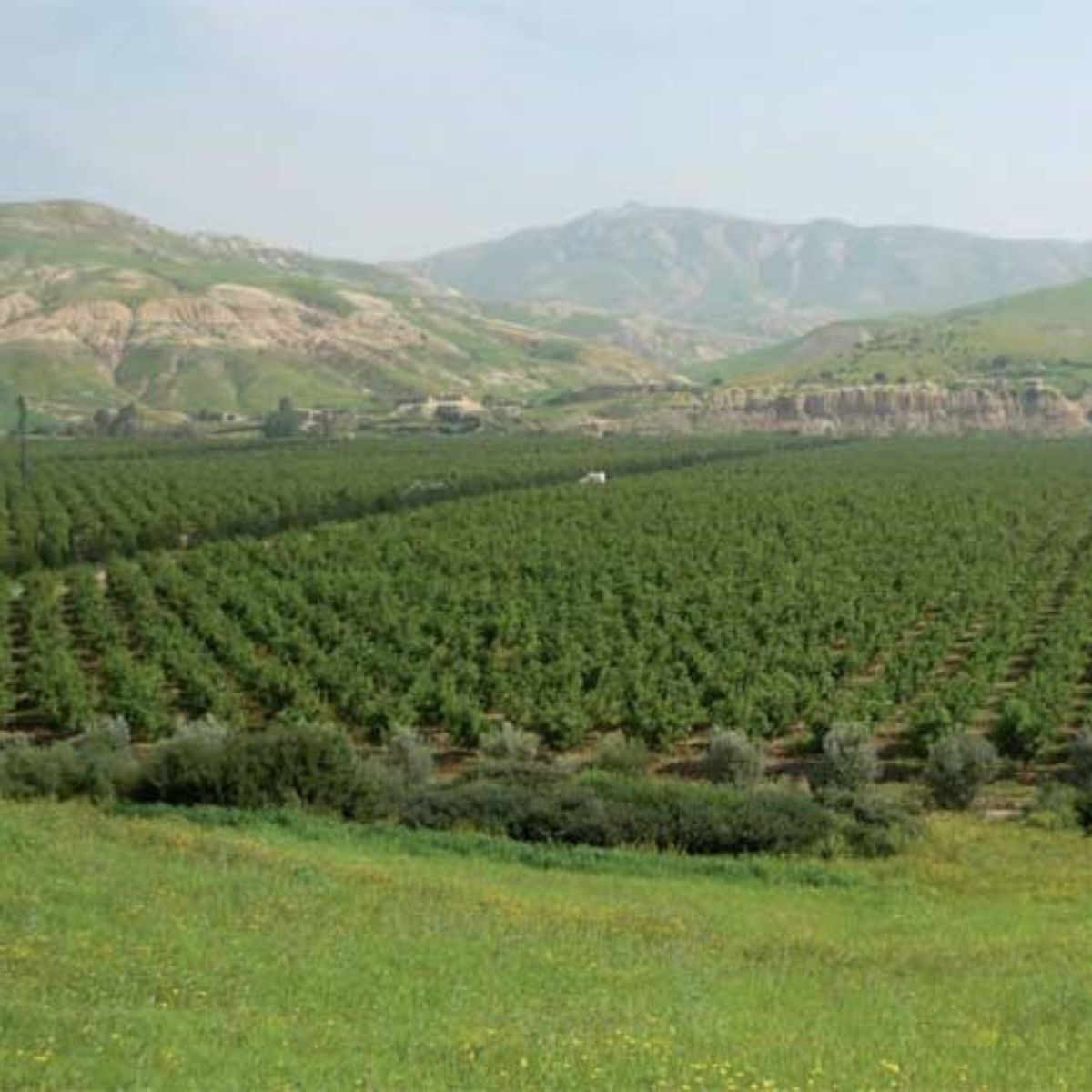
The Saïss plain is one of the most important agricultural areas in
Morocco. Over several thousand hectares, it concentrates diversified agriculture
based on market gardening, arboriculture and fodder crops.
The farms established there generate income for a significant share
of the rural population and contribute to supplying a large part of national markets.
For decades,
groundwater supported crop intensification and agricultural
investment. Then the context changed. Droughts became more frequent. Rainfall
decreased. Needs increased. The use of deep boreholes became widespread, often
without sufficient regulation.
Today, the Saïss aquifer records a structural deficit estimated at nearly 137 million
m³ per year.
This deficit is not the result of a single factor. It stems from several measurable climatic changes that directly affect the Saïss plain. The indicators below provide a concise overview.
1.8°C increase on average over the past 50 years.
Rainfall has dropped by around 30%, significantly reducing aquifer recharge.
47.1 °C in Meknès and up to 90 days of extreme heat per year (>35 °C).
The hydro-agricultural development project for the preservation of the Saïss plain is based on
a simple principle: replacing part of groundwater withdrawals with a regulated surface
water resource, more compatible with the natural renewal of aquifers.
This resource
comes from the M’Dez dam, built on the upper Sebou. The dam plays a dual role.
It protects downstream areas against floods and makes it possible to store a mobilizable resource.
Its capacity is about 700 million m³, and the regulated volume is 125 million
m³ per year, intended for irrigation in the Saïss plain.
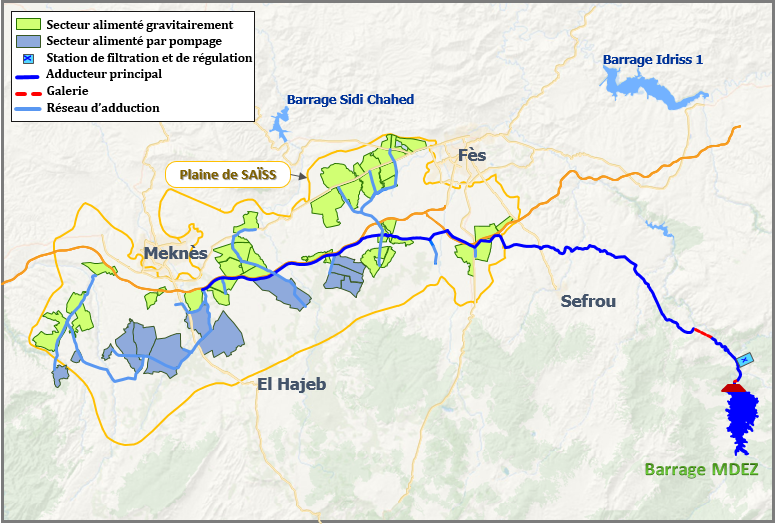
From the dam onward, the project relies on a substantial chain of hydraulic structures:
The Saïss project is a structuring intervention designed to respond to a profound
water imbalance and to support Saïss agriculture in an increasingly
challenging climate context.
In concrete terms, it aims to replace a significant share of groundwater pumping, to slow down
the decline of the aquifer and to stabilize farming conditions. This stabilization
is essential to preserve existing investments, estimated at several billion dirhams,
and to maintain the productive capacity of the territory.